Many of my clients are new to yachting, and one of the first things they ask is whether there is a good book on buying a yacht. For buyers planning a custom superyacht, Mega Yacht Wisdom II by former captains Buddy Haack and Doug Hoogs is a worthwhile read. For everyone else, especially those buying a pre-owned yacht, there is surprisingly little that pulls the whole picture together. This guide to buying a yacht is my attempt to do that.
No one wants to make a mistake on any purchase, least of all an expensive one. The right yacht is not simply the largest or newest you can afford. It is the one that fits your budget, your cruising plans, your family and guests, and your appetite for maintenance, and that will still be easy to sell when the time comes.
This guide walks through the questions every buyer should answer: budget, cruising goals, size and layout, the main types of yachts, hull materials, sailboat considerations including keel types, speed, styling, age, new or used, resale, insurance and the buying process itself. It focuses on the US market and South Florida, where I have worked for decades.
Start With Your Budget
The first question is always the budget, and it needs to be realistic. What you can get depends on size, goals and price, and the market changes dramatically from one price bracket to the next.
Remember that the budget is not just the purchase price. Ownership brings maintenance and repairs, dockage, insurance, fuel, crew on larger yachts and periodic upgrades. A common rule of thumb is to plan for annual running costs of around 10 percent of the yacht’s value. Our guides on whether a yacht is a good investment and how to finance a yacht cover the numbers in more detail.
Define Your Cruising Goals
Do you want a yacht for weekends and the occasional week away, perhaps to the Florida Keys or the nearer Bahamas? Or one with “longer legs” that can safely reach distant islands and stay out for weeks at a time? The answer shapes everything else, for sailing yachts as well as motor yachts.
Size and Livability
Staying aboard for longer periods calls for a comfortable master stateroom, ideally full beam aft or midship, and generous outdoor living space on a flybridge or aft deck. Most people discover that this is a wonderful lifestyle and, in time, move up to a larger yacht that is comfortable for longer stays.
Draft
If you plan to cruise shallow waters such as the Florida Keys or the Bahamas, keep the draft modest, ideally between about 4 and 6 feet, or you will limit where you can go.
Seaworthiness, and a Happy Partner
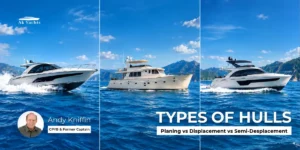
Seaworthiness is paramount. If your plans are marina to marina in protected waters, you may never face the seasick partner at the rail declaring, “This isn’t my idea of fun!” If you plan to cruise to the Caribbean or other open waters, a light planing cruiser is not the right choice. A semi-displacement or displacement yacht with stabilizers is far more comfortable and capable. Our guide to planing vs displacement hulls explains the difference.
Guests, Crew and Family
One of the joys of yachting is sharing it. Once you are away, friends and family will want to join you, so think about how many staterooms will often be in use and how long people can comfortably share the space. The ideal yacht allows owners and guests to enjoy time together and time apart. On larger yachts, the crew also need comfortable quarters to do their demanding jobs well. If young children will be aboard, look for safe stairways and layouts without dangerous ladders or spaces.
Types of Yachts
Understanding the main yacht types helps narrow the search quickly:
- Motor yachts. Spacious cruising yachts, typically with a flybridge, salon, galley and several staterooms. They range from about 40 feet to well over 100 feet. View our motor yachts for sale.
- Sportfishing yachts. Built for offshore fishing, with a large cockpit, powerful engines and a fast, seakindly hull. Many double as comfortable family cruisers. See our sport fishing yachts for sale.
- Express cruisers. Sleek, open yachts with a single main deck level and accommodation below, ideal for day trips and weekends. See our express yachts for sale.
- Center consoles. Open, outboard-powered boats for fishing, diving and day trips, now available well over 40 feet. See our center console boats for sale.
- Trawlers and expedition yachts. Displacement or semi-displacement yachts built for economy, range and comfort at modest speeds, ideal for long-distance cruising. See our used trawler yachts for sale.
- Sailing yachts. Monohulls and catamarans powered by the wind, valued for range, quiet and the pleasure of sailing. See our sailing yachts for sale.
- Catamarans. Twin-hulled sail and power yachts offering stability, wide living spaces and shallow draft.
- Superyachts and megayachts. Professionally crewed yachts, generally from about 79 feet (24 meters) upward. See our mega yachts for sale.
Our guide to yacht engines explains how propulsion choices differ across these types.
Boat Materials
Most production yachts today are built of fiberglass, but the hull material affects weight, strength, maintenance and value:
- Fiberglass (FRP or GRP). The most common material, durable and relatively easy to maintain and repair. Many hulls use cored construction, with foam or balsa between fiberglass skins, to save weight.
- Advanced composites. Carbon fiber and aramid reinforcements are used in high-performance and larger yachts for strength with less weight, at higher cost.
- Aluminum. Light, strong and common in custom yachts, superstructures and expedition yachts. It needs careful attention to electrical systems to prevent corrosion.
- Steel. Very strong and common in larger and expedition yachts, but heavy and in need of diligent corrosion control.
- Wood. Beautiful and traditional, found in classic yachts and some modern wood-epoxy builds, but demanding to maintain.
A glossary of yachting terms explains coring, gelcoat and other construction terms.
Buying a Sailboat
Many of the same rules apply to sailing yachts, with a few additions. Decide between a monohull and a catamaran, consider how easily the boat can be sailed by your usual crew, and check the age and condition of the rig and sails, which can be costly to replace.
Types of Keels on Sailboats
The keel has a major effect on performance, stability and where you can sail:
- Full keel. Runs most of the length of the hull. Steady and forgiving at sea, but slower and harder to maneuver in tight spaces.
- Fin keel. A shorter, deeper keel that improves speed and maneuverability. Common on modern cruisers and racers.
- Bulb keel. A fin keel with a weighted bulb at its base, lowering the center of gravity for stability with less draft.
- Wing keel. A shallower keel with wings at the bottom, designed to reduce draft while keeping stability.
- Centerboard or lifting keel. Can be raised to reduce draft dramatically, ideal for shallow waters such as the Bahamas.
- Twin or bilge keels. Two keels allowing the boat to sit upright when the tide goes out.
For Florida and Bahamas cruising, shallower draft options are often worth a small trade-off in upwind performance.
Not Sure Which Yacht Suits You?
Andy Kniffin, CPYB, works with buyers of power and sailing yachts, matching the market to each client’s goals and budget. A conversation costs nothing. Learn more about our Fort Lauderdale yacht broker service.
The Need for Speed
Is 12 knots too slow for you, or is the cost of filling the tanks at a few thousand dollars a time more troubling? Many owners settle this question after a few fill-ups. Every yacht has a “sweet spot” where it delivers the best balance of speed and fuel economy. Seven knots can get old, but cruising at 10 to 12 knots brings real advantages in fuel economy and range between fuel stops. Some yachts are designed to be comfortable at slower speeds, while others are not. Our guide to yacht fuel consumption shows how much speed costs.
Yacht Styling
We all have a sense of what looks good, and like choosing a car, the yacht should feel like you. Buy a yacht you love to look at. But styling brings trade-offs. Sleek European designs often sacrifice interior volume, while yachts designed for the American market, including many built in Taiwan, emphasize volume and livability. The same is true of sailing yachts.
Age, Parts and Service
Are you handy with repairs, or is newer equipment more important to you? An older yacht will need more monitoring and repairs as its equipment ages, and the availability of parts and technicians matters. Older Detroit Diesel engines, for example, are still widely supported, and mechanics who know them can be found on many islands. Modern electronically controlled engines usually need factory-trained technicians and diagnostic equipment.
As you cruise farther from major coastal centers, which is the whole point for many owners, service and parts become harder to find. Foreign-built yachts may use parts that are difficult to obtain locally. Fortunately, South Florida is a mecca for yacht parts and service of every kind. Our guide on what to look for when buying a used boat covers age, maintenance history and country of origin in more detail.
New or Used?
A new yacht offers the latest design, technology, a full warranty and the chance to choose finishes and options. Expect a build or delivery wait, a payment schedule tied to milestones and a commissioning and teething period in the first year. Have an independent surveyor inspect a new yacht before you accept delivery, and protect deposits with clear contract terms. For foreign-built yachts, import duty and tariffs can change the delivered cost.
A well-maintained used yacht offers value, because the first owner has absorbed the steepest depreciation, and it can be inspected exactly as it is. Our comparison of new vs used boats sets out the trade-offs.
Resale Value
What looks like a bargain that meets all your needs can turn out to be hard to sell later. Repossessed yachts and deep bargains are often badly neglected. I have resold more than a few for owners who spent double their budget or more bringing them back into shape, and who promised themselves never to try it again. These boats are best left to experienced buyers who can do much of the work themselves.
Tastes also change over time, and custom or one-off yachts tend to have small resale markets. For most buyers, I recommend production yachts with proven desirability and popular options. Seasoned buyers look for value, but also for a yacht that has been maintained by an owner who is proud of it.
Insurance
Check insurance before you commit to a purchase. Underwriters require the owner to be competent to operate the yacht or to employ a qualified captain. Many restrict where a yacht can be during hurricane season, and the Florida marine insurance market has tightened in recent years, with higher premiums and stricter conditions. Speak to an experienced marine insurance agent early, especially for older or larger yachts.
Things to Know Before Owning a Yacht
Beyond the purchase, ownership brings responsibilities: registering and titling the yacht, paying applicable sales or use tax, maintaining it properly, arranging dockage, keeping safety equipment current and operating it competently. Our guides to yacht registration USA, yacht maintenance tips and how to secure a luxury yacht cover these essentials.
How to Purchase a Yacht
Once you know what you want, the purchase follows a well-established process: find the yacht with your broker, make an offer, sign a purchase agreement with a deposit in escrow, complete a survey and sea trial, accept or negotiate, and close. Our tips for used yacht buyers walk through each step, and our guides to yacht purchase agreements and the yacht survey explain the key stages.
A competent broker who understands your goals and has real sea-going experience makes the whole process much easier. Our article on why a buyer’s yacht broker makes sense explains how buyer representation works.
Conclusion
Buying a yacht is one of the most rewarding decisions you can make, and for many it opens a lifestyle like no other. The key is to be honest about your budget, clear about how you will use the yacht and realistic about maintenance and resale. Choose the type, size and hull that fit your plans, buy a well-kept yacht with proven appeal and work with professionals who know the market.
Thinking of Buying a Yacht?
Call Andy Kniffin, CPYB, for a free, no-obligation consultation. He will help you define what you need and find the right yacht at the right price. View our yachts for sale , or if you are moving up, learn how we help owners sell your yacht .
Frequently Asked Questions
What should I consider when buying a yacht?
Start with your total budget, including running costs, and how you plan to use the yacht. Then consider size and layout, draft, seaworthiness, speed, the type of yacht, hull material, age, parts and service availability, resale value and insurance.
What are the main types of yachts?
The main types include motor yachts, sportfishing yachts, express cruisers, center consoles, trawlers and expedition yachts, sailing yachts, catamarans and superyachts.
What is the best material for a yacht?
Fiberglass is the most common and practical for most buyers. Aluminum and steel suit larger custom and expedition yachts, carbon composites suit high-performance builds and wood suits classic yachts. Each has different maintenance needs.
What are the different types of sailboat keels?
The main types are full keels, fin keels, bulb keels, wing keels, centerboards or lifting keels, and twin or bilge keels. Each balances performance, stability and draft differently.
What are your top tips for buying a sailboat?
Choose between a monohull and a catamaran based on your plans, check the condition and age of the rig and sails, consider the keel type and draft for your cruising area, and make sure the boat can be handled easily by your usual crew. Always get a survey.
What should I know before buying a new yacht?
Expect a wait for build or delivery, milestone payments and a first-year teething period. Protect your deposits with clear contract terms, have the yacht independently inspected before acceptance, and for foreign-built yachts, check import duty and tariffs.
How much does it cost to own a yacht each year?
A common rule of thumb is around 10 percent of the yacht’s value per year, covering maintenance, dockage, insurance, fuel and crew, though it varies widely with size, age and use.
Do I need a broker to buy a yacht?
It is not required, but a buyer’s broker usually costs you nothing directly, since the seller normally pays the commission, and brings market knowledge, negotiation and transaction support.
This guide provides general information only and is not legal, tax, insurance or financial advice. Consult qualified professionals about your situation before buying a yacht.