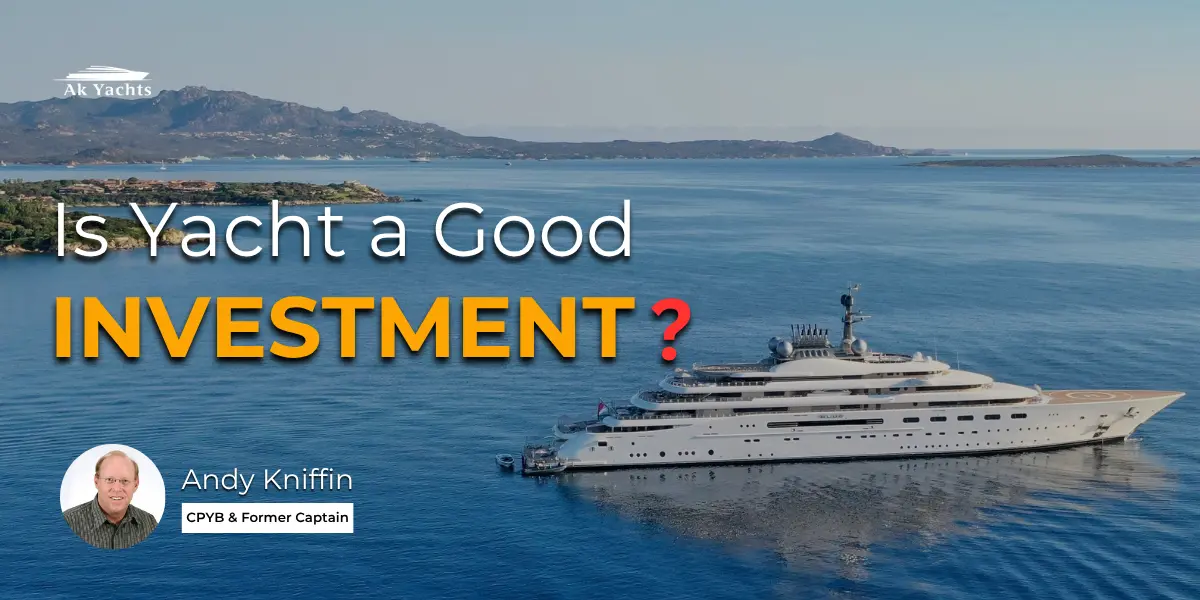
‘Is yacht a good investment?’ is one of the first questions almost every prospective buyer asks, and the honest answer is that it depends entirely on how you define ‘investment.’ If you mean an asset that appreciates in value like a stock or a piece of real estate, a yacht generally will not deliver that outcome. If you mean an asset that can offset its own costs, generate income through a charter program, and deliver years of experiences that most other purchases simply cannot, then for the right buyer, yes, a yacht can be a very good investment indeed.
This guide breaks down exactly what that means in practice. We will look at what actually makes yacht ownership worthwhile, how depreciation really works compared to other assets, the different ownership and charter models available to you, what the numbers look like across various regional markets, and what real owners say when you ask them directly. By the end, you should have a clear framework for deciding whether buying a yacht fits your goals, whether that is a 35-foot weekend cruiser or a 100-foot motor yacht.
This guide focuses on the US yacht market, with particular attention to South Florida, which remains the largest and most active yacht ownership and brokerage market in the country.
What Makes Yacht Investments Worthwhile
Before diving into numbers, it helps to separate two different kinds of return: financial return and lifestyle return. Competitor guides often blur these together, but treating them separately actually makes the decision easier.
The Lifestyle Return Is Real, and It Counts
Owning a yacht gives you access to destinations, experiences, and quality time that are difficult to put a price on, but that does not mean they have no value. If a family of four would otherwise spend $15,000 to $20,000 (50,000 or more) a year on vacation rentals, flights, and resort stays, and instead spends that time on their own boat, the yacht is offsetting a real expense even before any charter income enters the picture. This is the same logic many people apply to owning a vacation home, and it is worth applying to yacht ownership as well.
Understanding Your Real Annual Costs: The 10 Percent Rule
The most important number in this entire guide is one that most first-time buyers underestimate: plan to spend roughly 10 (10-15) percent of your yacht’s purchase price every single year on ownership costs. For a $500,000 yacht, that is approximately $50,000 a year. For a $2 million yacht, it is roughly $200,000 a year.
This figure covers a combination of costs that vary by vessel size, location, and usage pattern:
- Dockage and marina fees, which in South Florida alone can run $2,000 to $6,000 or more per month depending on vessel length and marina
- Insurance, typically 1 to 1.5 percent of the vessel’s insured value annually for standard leisure use, higher for mega yachts or charter operations
- Routine maintenance and detailing, including hull cleaning, bottom paint, and diesel engine servicing
- Fuel, which scales heavily with vessel size and engine hours
- Crew salaries, if applicable, for vessels large enough to require a captain or full crew
- Haul-outs, surveys, and periodic refits
None of this means a yacht is a bad purchase. It means the purchase price is the entry fee, not the full cost of admission. Buyers who plan for the 10 percent rule from day one rarely feel blindsided. Buyers who do not are the ones who end up selling within two years, often at a loss, simply because the ongoing costs were never part of the original budget.
Maintenance as a Value-Preserving Strategy
Here is where a yacht behaves more like a piece of real estate than most people expect. A well-maintained vessel holds its value significantly better than one that has been neglected, and the gap widens every year. Routine maintenance of the yacht’s finish, systems, and engines is not just about enjoying the boat today. It directly protects what you will be able to sell it for later, and it affects how quickly a future buyer’s surveyor signs off on the vessel.
Think of routine maintenance spending as a form of forced savings that comes back to you at resale, rather than as money disappearing into the boat.
Already planning your purchase and want to understand the financing side of these numbers? See our complete guide on how to finance a yacht , covering loan rates, down payments, and lender options for the US market.
Yacht Depreciation vs Asset Appreciation
This is the section where most buyers want a straight answer, so here it is: yachts are depreciating assets, full stop. A new yacht typically loses 10 to 15 percent of its value in the first year alone, and then continues depreciating at roughly 5 to 8 percent annually for the next several years before the curve flattens out. By year ten, a yacht might retain somewhere between 40 and 55 percent of its original purchase price, depending heavily on brand, condition, and how it was used.
Why Yachts Depreciate Differently Than Cars?
The comparison to cars is useful but imperfect. Cars depreciate fast and predictably because of mass production, frequent model-year changes, and a massive used market with consistent comparables. Yachts depreciate more slowly in percentage terms once past the first couple of years, largely because production volumes are lower, each vessel tends to be more individually equipped, and the used market is thinner, which means good examples in good condition can hold value surprisingly well.
What Actually Helps a Yacht Hold Its Value?
Four factors consistently separate yachts that hold value from ones that do not:
- Builder reputation and resale demand. Builders with strong reputations for build quality and a healthy used market, including names like Hatteras, Viking, Ferretti, and Sunseeker, certain mass produced brands (like Sea Ray) tend to hold value better than obscure brands.
- Maintenance history and documentation, including service records, recent surveys, and evidence of timely engine and systems work
- Original condition versus heavy personalization, since highly customized interiors can actually narrow the buyer pool at resale
- Total engine hours relative to age, which is one of the first things any serious buyer’s broker will check
Can a Yacht Ever Appreciate?
In rare cases, yes, but treat this as the exception, not the plan. Limited-production yachts from boutique builders, vessels with unusual history or provenance, and boats purchased during a market downturn and sold during a strong market can occasionally sell for more than their original price, particularly when adjusted for inflation. But building a purchase decision around the hope of appreciation is the wrong approach. The right approach is buying a vessel that depreciates slowly, costs are managed well, and the lifestyle and potential charter income offset the depreciation over the ownership period.
If you are weighing a new build against a pre-owned yacht, this is one of the strongest arguments in favor of buying used. The steepest depreciation curve, that first-year 10 to 15 percent drop, has already happened to someone else.
Looking for the Right Yacht?
Whether you are comparing yacht brands, reviewing financing options, or preparing to buy your next vessel, AK Yachts can help you make a confident decision with expert brokerage guidance.
Yacht Ownership and Charter Models
How you structure ownership has a bigger impact on the financial outcome than almost any other decision you will make. Here are the main models available to US-based owners, ranging from purely personal use to fully commercial operations.
Private Ownership for Personal Use Only
The simplest model: you own the boat, you use it whenever you want, and there is no income to offset costs. This is the right choice for owners who value flexibility and privacy above all else and who do not want to deal with charter guests, scheduling conflicts, or the wear and tear that comes with commercial use. The tradeoff is that you are absorbing 100 percent of the 10 percent annual cost rule yourself.
Owner-Operated Charter (Part-Time Charter)
Many owners, particularly of vessels in the 80 foot plus range, choose to charter their yacht for a portion of the year while reserving blocks of time for personal use. A well-positioned yacht in a strong charter market can generate enough income during peak season to materially offset annual running costs, sometimes covering 30 to 60 percent of the 10 percent rule depending on the vessel, location, and how aggressively it is marketed.
Understanding typical charter rates and how long the charter season runs in your target market is essential before assuming any specific income figure. A 80 foot plus motor
yacht chartering in South Florida or the Bahamas during peak winter season can
command meaningfully different rates than the same vessel sitting idle in a slower
regional market. Buyers considering a vessel currently registered or located outside the US, including yachts for sale in Europe, should understand that import duties, VAT exposure, and documentation requirements can add meaningful cost and complexity.
Fully Managed Charter Programs
For owners who do not want to manage bookings, crew, or guest logistics themselves, charter management companies handle the entire operation in exchange for a percentage of charter revenue, typically in the 20 to 30 percent range. This model works well for larger crewed yachts where the owner is often traveling and cannot personally coordinate charter scheduling. The tradeoff is less personal flexibility, since the vessel needs to be available during the periods the management company has booked.
Fractional Ownership and Yacht Clubs
Fractional ownership programs allow multiple owners to share the purchase cost, ongoing expenses, and usage time of a single vessel, typically structured around a set number of weeks per year per owner. This model has grown in popularity for buyers who want yacht access without the full financial commitment of solo ownership. Membership-based yacht clubs offering access to a fleet of vessels are a related option, particularly appealing to buyers who are not yet ready to commit to ownership of a specific boat.
Crewed vs Bareboat: What It Means for Your Numbers
If you are considering chartering your vessel, the crewed-versus-bareboat distinction matters enormously for both income and cost. A crewed charter typically commands a significantly higher weekly rate, since it includes a captain and often additional crew, but it also means the owner is responsible for crew salaries year-round in most arrangements, not just during charter weeks. Bareboat charter (where guests operate the vessel themselves) is more common for sailing catamarans and monohulls and carries lower per-week rates but also lower ongoing crew costs for the owner.
Global and Regional Yacht Investment Markets
Where you buy, register, and operate your yacht has a direct effect on both costs and resale value. The US yacht market is large and diverse enough that regional differences matter significantly.
South Florida: The Center of the US Market
Fort Lauderdale and the broader South Florida region remain the densest concentration of yachts for sale, brokers, service yards, and marinas in the United States. For owners, this means easier access to qualified service technicians, a deeper pool of charter guests during the winter season, and historically the strongest resale liquidity, meaning yachts here tend to sell faster than comparable vessels in less active markets. If you are weighing where to register and primarily berth your vessel, South Florida dockage and US yacht registration requirements are both worth reviewing early.
Other US Regional Markets
Markets outside South Florida can offer real advantages depending on your goals. The Pacific Northwest and New England have strong sailing cultures and active club scenes. The Great Lakes region, including states like Michigan, has a passionate seasonal boating community, though winter lay-up costs need to be factored into the annual budget. Coastal markets such as North Carolina and Texas offer lower dockage costs than South Florida but with smaller buyer pools at resale time, which can mean longer time on market when you eventually sell.
International Considerations
Buyers considering a vessel currently registered or located outside the US, including yachts for sale in Europe, should understand that import duties, VAT exposure, and US Coast Guard (remove US Coast Gaurd) documentation requirements can add meaningful cost and complexity. This is an area where working with an experienced broker who has handled international transactions before is particularly valuable, since the paperwork and timeline can catch first-time buyers off guard.
Reading the Market: Is Now a Good Time to Buy?
Yacht market conditions move in cycles, much like real estate, and ‘when will the boat market crash’ is a question that comes up periodically, especially after periods of rapid price growth. Rather than trying to time the market precisely, focus on what you can control: buying a vessel with strong resale fundamentals (reputable builder, good maintenance history, sensible size for your actual usage pattern), and having a realistic ownership timeline of at least 3 to 5 years. Yachts purchased and sold within a year or two almost always show the worst financial outcomes, regardless of broader market conditions, simply because the first-year depreciation hit has not had time to be offset by usage value or charter income.
Tax Considerations for US Yacht Owners
This section is not covered in most yacht investment guides, but it is one of the most common follow-up questions buyers have once they understand the basic cost picture.
The Second-Home Mortgage Interest Deduction
If you finance your yacht and it has a sleeping berth, a galley, and a head, it may qualify as a second home under US tax law, potentially making the loan interest deductible in the same way as a second-home mortgage. This is not automatic and depends on your overall tax situation, including whether you itemize deductions and your total mortgage debt across all properties. For a full breakdown of how yacht loans are structured and what qualifies, see our guide to financing a yacht.
Charter Income and Business Use
If you operate your yacht in a charter program, the income is taxable, but a portion of your ownership expenses, including depreciation, maintenance, dockage, and insurance, may be deductible against that income, depending on how the activity is classified and how many days the vessel is used for charter versus personal use. This is an area where the rules are genuinely complex and where the cost of a qualified marine-industry accountant is almost always worth it. Get this conversation started before you buy, not after your first charter season.
Sales Tax and Use Tax
Sales and use tax on yacht purchases varies significantly by state, and where you take delivery, where you register the vessel, and where you primarily operate it can all affect your tax exposure. Florida, for example, caps use tax on vessels at a set maximum amount regardless of purchase price, which is one reason South Florida remains attractive for larger purchases. Work with your broker and a tax professional to understand the implications specific to your situation before closing.
None of the above is tax advice. Tax treatment of yacht ownership depends on your individual circumstances and may change as tax laws evolve. Always consult a qualified tax professional familiar with marine assets before making decisions based on potential deductions.
What Real Owners Say? Perspectives from the Boating Community
Online discussions among boat owners consistently echo a few themes that are worth highlighting, because they reflect lived experience rather than marketing copy.
The Most Common Advice: Buy Less Boat Than You Think You Need
Experienced owners frequently caution new buyers against over-buying on size and complexity. A boat that is slightly smaller than your dream vessel but that you can comfortably afford to run, maintain, and use often, gets used far more than a larger boat that sits at the dock because the owner is hesitant about fuel costs or maintenance complexity. A boat that gets used delivers far more lifestyle return per dollar than one that does not.
The ‘Boat Unit’ Reality
Long-time owners often joke about the unpredictable cost of repairs and parts, where seemingly small issues can result in unexpectedly large bills. The takeaway for new buyers is not that maintenance is unaffordable, but that a maintenance reserve fund, separate from your regular budget, removes most of the stress around these costs when they come up. Owners who keep 5 to 10 percent of the vessel’s value in reserve for unplanned repairs report far less financial anxiety around ownership than those who do not.
The Honest Verdict on ‘Investment’
When asked directly whether a boat is a good investment, most experienced owners give a version of the same answer: no, not in the financial sense, but the value it provides in family time, relaxation, and shared experiences is something they would not trade for the money. The owners who report being happiest with their purchase are consistently the ones who went in with realistic cost expectations and bought a vessel matched to how they actually planned to use it, not how they imagined using it.
A Simple Framework for Deciding If a Yacht Is Right for You
Pulling everything together, here is a practical way to think through the decision:
- Can you comfortably budget 10 percent of the purchase price annually for running costs, without relying on charter income to make that number work?
- Will you realistically use the vessel often enough that the lifestyle value offsets a portion of the depreciation, even if there is no charter income at all?
- If considering charter income, have you researched actual rates and season length for your specific vessel type and location, rather than assuming a number?
- Do you have a maintenance reserve separate from your purchase budget for unplanned repairs?
- Is your ownership horizon at least 3 to 5 years, giving the depreciation curve time to flatten before resale?
If you answered yes to most of these, a yacht can be a sound addition to your life, financially sustainable even if it is not a financial investment in the traditional sense. If several of these give you pause, it may be worth looking at smaller or more affordable vessels, a pre-owned boat that has already absorbed the steepest depreciation, or a fractional/club model before committing to full ownership.
Whatever direction you are leaning, working with an experienced buyer’s yacht broker from the start helps you avoid the most common and most expensive mistakes, particularly around vessel selection, survey findings, and realistic cost expectations. If you are ready to start exploring specific vessels, browse AK Yachts’ full inventory of yachts for sale, including motor yachts, sailing yachts, sport fishing yachts, and mega yachts.
Conclusion: So, Is Yacht a Good Investment?
In the strict financial sense, no. A yacht will not behave like a stock portfolio or an appreciating piece of real estate, and anyone telling you otherwise is selling something. But that is the wrong question to be asking in the first place.
The better question is whether the combination of lifestyle value, potential charter income, and manageable ongoing costs adds up to something worth the money for your specific situation. For buyers who budget realistically using the 10 percent rule, choose a vessel with strong resale fundamentals, maintain it properly, and use it the way they actually planned to, yacht ownership can be one of the most rewarding purchases they ever make, financially sustainable even if it is not, strictly speaking, a financial investment.
The owners who regret their purchase are almost always the ones who skipped the cost planning, bought more boat than they could comfortably run, or assumed charter income would cover costs without checking the actual numbers for their market. Avoid those three mistakes, and the odds shift heavily in your favor.

Speak With Andy Kniffin
Andy Kniffin is a CPYB Certified Professional Yacht Broker and Former Captain, helping yacht buyers and sellers make confident decisions with practical market insight and hands-on yachting experience.
Frequently Asked Questions
Is buying a yacht a good investment?
Not in the traditional financial sense. Yachts are depreciating assets, typically losing 10 to 15 percent of value in the first year and continuing to depreciate after that. However, when you factor in lifestyle value, potential charter income, and the offset of vacation costs you would otherwise pay elsewhere, many owners find yacht ownership financially sustainable and personally rewarding, even though it is not an appreciating investment.
How much does it cost to own a yacht per year?
A widely used rule of thumb is to budget approximately 10 percent of the yacht’s purchase price annually for running costs, including dockage, insurance, maintenance, fuel, and crew if applicable. For a $500,000 yacht, that is roughly $50,000 per year. Costs vary by vessel size, age, location, and how the boat is used.
Do yachts ever appreciate in value?
It is rare. Most yachts depreciate steadily over their ownership life. In limited cases, yachts from boutique or limited-production builders, vessels with notable history, or boats bought during a downturn and sold during a stronger market can sell for close to or occasionally above their original price when adjusted for inflation, but this should never be the basis for a purchase decision.
Can chartering my yacht cover its costs?
Partially, in many cases. Owners who place their yacht in a charter program, whether self-managed or through a charter management company, can offset a meaningful portion of their annual running costs during peak season, particularly for vessels in popular charter destinations. Full cost coverage is uncommon and depends heavily on vessel type, location, and how actively the boat is marketed for charter.
Is it better to buy a new or used yacht as an investment?
From a pure depreciation standpoint, buying used is generally the stronger financial choice, since the steepest depreciation, the 10 to 15 percent first-year drop, has already occurred. A well-maintained used yacht from a reputable builder can offer better value retention going forward than a new vessel of the same model.
What yacht brands hold their value best?
Builders with strong reputations for build quality, sufficient production volume to support a healthy resale market, but not so much volume that the market is flooded, tend to hold value best. Maintenance history, total engine hours, and original condition matter as much as the brand name itself when it comes to resale value.
Are there tax benefits to owning a yacht?
Potentially, depending on your situation. If the vessel qualifies as a second home (with a sleeping berth, galley, and head) and is financed, loan interest may be deductible similarly to a second-home mortgage. If the yacht is used for charter, certain expenses may be deductible against charter income. These rules are complex and situation-specific, so consult a tax professional familiar with marine assets before making decisions based on potential deductions.
How long should I plan to own a yacht for the numbers to make sense?
Most experienced owners and brokers recommend a minimum ownership horizon of 3 to 5 years. Yachts sold within the first year or two almost always show the worst financial outcomes, since the steepest depreciation has not yet been offset by years of usage or potential charter income.