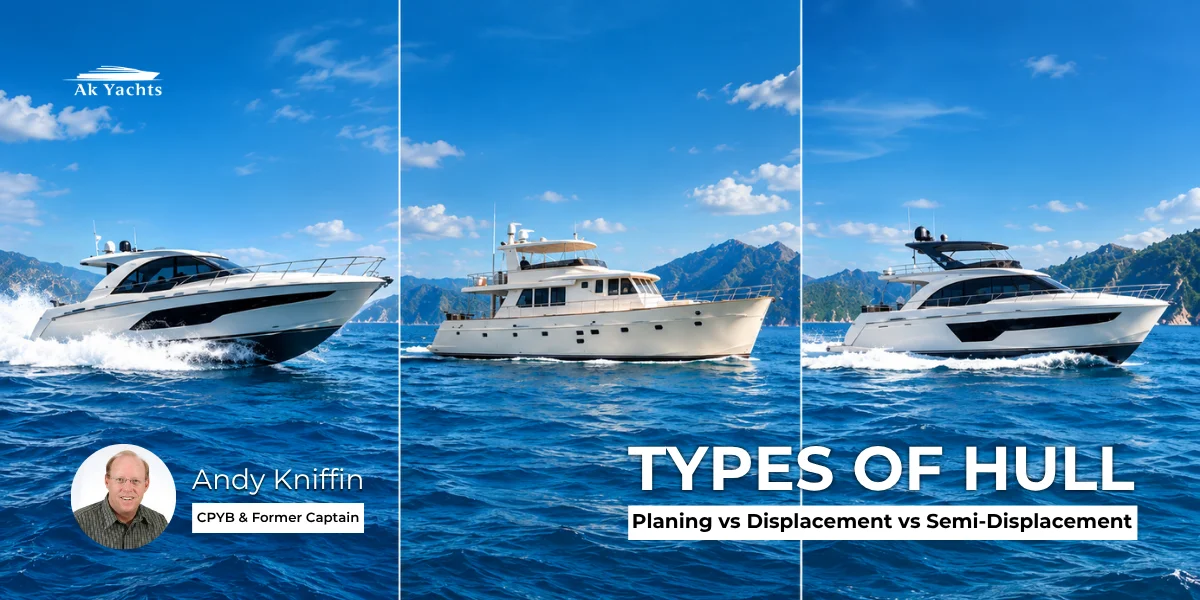
If you are in the process of buying a yacht, you will encounter the words 'displacement hull,' 'planing hull,' and 'semi-displacement hull' in almost every listing description, sea trial report, and broker conversation. Hull type is not just a technical specification. It shapes how a yacht moves through the water, how much fuel it burns, how comfortable the ride is in different sea states, and what kinds of trips it is suited for.
This guide covers all three hull types in plain terms, including what each one actually is, how it performs across key characteristics, what kinds of vessels use each design, and how to think about which one fits what you actually want to do on the water. If you are not yet familiar with some of the terminology, the glossary of yachting terms on our site covers a lot of the definitions that come up in boat shopping.
What Is a Displacement Hull?
A displacement hull is designed to move through the water rather than on top of it. The hull sits partially or fully submerged at all times, and the boat moves forward by pushing water aside. This creates a predictable wave pattern on either side of the bow as the hull travels.
The key consequence of this design is a natural speed ceiling. As a displacement hull moves faster, the bow wave it generates grows, and at a certain speed the boat is essentially climbing its own wave, which requires exponentially more power. This ceiling is described by the concept of hull speed, which is proportional to the square root of the waterline length. For most displacement vessels, hull speed falls in the range of 7 to 12 knots depending on length, and exceeding it is technically possible but not practically efficient.
Key Characteristics
Underwater Profile
Displacement hulls typically have a rounded or deep-V underwater shape. The hull has more depth and volume below the waterline, which contributes to the smooth and stable motion in waves. A sailboat's full keel is the classic example.
Stability
Excellent. Because displacement hulls sit deeply in the water with a lower center of gravity, they are inherently stable platforms. They do not bounce on the water surface the way a planing hull does. In open ocean conditions, this stability difference becomes very noticeable very quickly.
Ride Comfort
A well-designed displacement hull slices through waves rather than pounding over them. Passengers experience a smooth, rolling motion rather than the jarring impact that can occur on lighter, faster hulls in choppy conditions. This is one reason long-range cruisers and liveaboards consistently favor displacement designs.
Speed
Slow by the standards of planing boats. Most displacement yachts cruise in the 7 to 12 knot range. This is not a flaw in the design, it is a consequence of the tradeoff that makes everything else about displacement hulls work.
Fuel Efficiency
Displacement yachts are typically 1.5 to 3 times more fuel efficient than comparably sized planing hulls at their respective cruise speeds. Over a long offshore passage, this difference translates to meaningfully lower fuel costs and significantly greater range before needing to refuel.
Ease of Handling
Predictable. Displacement hulls respond gradually and are forgiving in most conditions. They are generally considered easier to manage in rough water than planing hulls, though their deeper draft can limit access to shallow anchorages.
Common Displacement Hull Vessels
The following vessel types are typically built around displacement hull designs. If any of these sound like the right fit for how you plan to use the water, the inventory links below are a good starting point.
- Trawlers: purpose-built for long-range, fuel-efficient cruising. Ideal for full-time liveaboards and bluewater passages
- Sailing yachts: keelboats of all sizes operate primarily as displacement vessels under both sail and engine
- Mega yachts: large expedition and long-range motor yachts above 80 to 100 feet are almost always displacement designs
- Cargo ships, tugboats, and ferries: all commercial displacement vessels at scale
Advantages
- Best fuel efficiency of the three hull types at cruising speed
- Outstanding range; suitable for transatlantic and offshore voyaging
- Smoothest ride in rough water and open ocean conditions
- Excellent stability; lower center of gravity
- Generally quieter at cruise speeds than planing designs
Disadvantages
- Inherently slower; hull speed is a real ceiling
- Deeper draft limits access to shallower anchorages and marinas
- Longer transit times for the same distance compared to faster hull types
- Less exciting to operate for buyers who prioritize speed and responsiveness
What Is a Semi-Displacement Hull?
A semi-displacement hull sits between the two extremes. At rest and at slow speeds, it behaves like a displacement hull, sitting in the water and pushing it aside. As speed increases, the hull generates some hydrodynamic lift and begins to rise slightly, reducing the wetted surface area and drag, but it does not fully climb out of the water the way a true planing hull does.
The practical result is a design that can cruise at meaningfully higher speeds than a displacement hull, typically 12 to 25 knots depending on the vessel and power, while retaining much better fuel efficiency and sea-keeping behavior than a planing hull at equivalent speeds. Semi-displacement hulls first became widely practical after World War II as engines became more powerful and construction materials became lighter.
Key Characteristics
Underwater Profile
A moderate-V shape with more pronounced deadrise than a flat planing hull, transitioning to flatter aft sections. The hull is generally shallower than a displacement design but has more depth than a pure planing hull. Most semi-displacement yachts require a keel of some kind and often active stabilizers to manage roll at cruise speed.
Stability
Good, but typically requires active assistance. Stabilizers, whether paravane-style, gyroscopic, or fin-based, are common on semi-displacement motor yachts because the hull does not have the inherent roll resistance of a full displacement design. With stabilizers fitted, comfort levels are very good.
Ride Comfort
Better than planing in chop, not as smooth as pure displacement in heavy seas. In the conditions most coastal and offshore cruisers encounter on typical passages, the ride is comfortable and practical.
Speed
The semi-displacement hull's main selling point. Where a trawler might cruise at 8 to 10 knots, a well-powered semi-displacement yacht of similar length can cruise at 16 to 22 knots, making it practical for longer passages without adding multiple days to the journey. Semi-displacement hulls work best on boats up to about 125 feet.
Fuel Efficiency
Better than planing, not as good as displacement. Semi-displacement hulls strike a compromise: they burn more fuel than a trawler covering the same distance, but significantly less than a planing boat traveling at a comparable speed. For many owners, this balance is exactly what they are looking for.
Ease of Handling
Responsive and predictable at cruise speed. Semi-displacement hulls are well-suited to experienced handlers and accessible to first-time owners of vessels in this size range with appropriate training.
Common Semi-Displacement Hull Vessels
- Motor yachts: the majority of mid-size motor yachts in the 40 to 80 foot range use semi-displacement designs
- Express yachts: express-style cruisers designed for moderate speed with comfortable offshore capability
- Long-range motor yachts: vessels built for extended coastal and offshore passages where the ability to cover ground efficiently matters
Advantages
- Faster than displacement designs; practical for longer passages without excessive journey times
- Better fuel economy than planing hulls at comparable speeds
- Good comfort and sea-keeping in typical offshore conditions
- Works well across a wide range of vessel sizes
- Versatile: handles both coastal cruising and offshore passages reasonably well
Disadvantages
- Typically requires active stabilization for comfort in beam seas
- Not as fuel-efficient as pure displacement designs for very long range voyaging
- Not as fast or responsive as a planing hull
- Higher complexity and cost in some designs due to stabilizer systems
What Is a Planing Hull?
A planing hull is designed to generate hydrodynamic lift as speed increases, allowing the hull to rise and skim across the water surface rather than pushing through it. At slow speeds, a planing hull behaves like a displacement hull. As power is applied and speed builds, the bow rises, the stern digs in temporarily, and then the hull climbs out of the water into the planing state, where most of its bottom is clear of the water surface and drag drops significantly.
This transition from displacement mode to planing mode is called 'getting on plane,' and it requires a meaningful power input relative to displacement. Once on plane, speed increases sharply and the boat becomes highly responsive. Fuel burn is also substantially higher than either of the other hull types at speed.
Key Characteristics
Underwater Profile
Flat or shallow-V bottom, sometimes with strakes or steps to improve lift and stability at speed. The hull has minimal depth compared to the other types, which means it sits very close to or on the water surface when underway.
Stability
Variable. Planing hulls can be stable at speed but feel less settled at rest or in following seas. In beam swells, some planing hulls will roll noticeably. Deep-V planing hulls handle rougher conditions better than flatter designs, but neither approaches the inherent stability of a displacement hull in open water.
Ride Comfort
Faster but rougher. A planing hull in choppy conditions will pound in a way that a displacement or semi-displacement hull will not. Ride quality depends heavily on sea state and on the specific hull design. Deep-V hulls handle chop better than flat-bottomed designs but still transmit more impact to passengers than a displacement vessel in the same conditions.
Speed
The strongest argument for a planing hull. A well-powered planing yacht can reach 30 to 50 knots or more. For sport fishing, day tripping, and covering short distances quickly, this capability is the whole point.
Fuel Efficiency
Poor relative to the other types at equivalent distances, though it varies significantly with how the boat is operated. On plane and at high speed, fuel consumption per nautical mile is substantially higher than either displacement or semi-displacement designs. The tradeoff is speed: covering ground faster means the engine runs for fewer hours, which partially offsets the higher per-hour consumption.
Ease of Handling
Very responsive and agile. Planing hulls react quickly to helm inputs and are satisfying to drive at speed. They require a degree of attention in varying sea conditions that displacement hulls do not, particularly in following seas where they can be susceptible to broaching if handled carelessly.
Common Planing Hull Vessels
- Sport fishing yachts: the dominant hull type for offshore tournament fishing boats and day fishing boats
- Center console yachts: nearly all center consoles use planing hull designs
- Bowriders, runabouts, and day boats: the most common recreational powerboat category
- High-performance express yachts: some larger express models push into planing territory with sufficient power
Advantages
- Highest top speeds of the three hull types
- Shallow draft when on plane; can access shallower water
- Very responsive and engaging to operate
- Ideal for short passages, day trips, and sport fishing
- Generally lower purchase price than comparable-length displacement designs
Disadvantages
- Highest fuel consumption per nautical mile at speed
- Rougher ride in choppy conditions
- Not suited to long offshore passages as efficiently as displacement designs
- Requires significant power; larger vessels become prohibitively expensive to run
- Less stable at rest and in following seas
Side-by-Side Comparison: All Three Hull Types
The diagram below represents the cross-sectional profile of each hull type viewed from the bow looking aft. The comparison table that follows covers performance and practical characteristics.
| Factor | Displacement Hull | Semi-Displacement Hull | Planing Hull |
|---|---|---|---|
| Hull profile |

|

|

|
| Hull shape | Rounded / deep-V below waterline | Moderate-V with flatter aft sections | Flat or shallow-V bottom |
| How it moves | Pushes through water | Partial lift; sits lower than planing | Rises on top of water surface |
| Typical speed | Below 10-15 kts (hull speed constrained) | 12-25 kts depending on design and power | 25-60+ kts depending on size |
| Fuel efficiency | Best; 1.5-3x more efficient than planing | Middle ground; better than planing | Poorest; high consumption at speed |
| Ride comfort | Exceptionally smooth; slices through seas | Good; better than planing in chop | Rougher in choppy seas |
| Stability | Excellent; lowest center of gravity | Good with stabilizers | Moderate; can hobby-horse in swells |
| Range | Very long; suited for blue-water voyaging | Moderate to long range | Limited by fuel consumption |
| Draft | Deeper; limits some anchorages | Moderate draft | Shallow when on plane |
| Handling | Predictable; slower to respond | Responsive at cruise speed | Very agile and responsive |
| Typical size | 35 ft to 300 ft+ | 35 ft to ~125 ft | Typically under 80 ft |
| Common types | Trawlers, long-range motor yachts, sailboats | Express cruisers, mid-size motor yachts | Sport fishers, center consoles, fast yachts |
| Best for | Long-range cruising, offshore voyaging, comfort | Versatile coastal and offshore use | Speed, sport fishing, day trips, short runs |
Need Help Comparing Hull Types?
Talk with Andy Kniffin, CPYB about how you plan to cruise and which yacht designs best match your priorities.
Which Hull Type Is Right for You?
The right hull is the one that matches how you actually plan to use the boat, not how you imagine using it in the best possible conditions. Here is a practical framework.
Choose a Displacement Hull If:
- Your primary interest is long-range cruising, offshore voyaging, or full-time liveaboard use
- Fuel efficiency and range matter more than transit speed
- You spend significant time in open ocean or offshore conditions where ride comfort over long hours matters
- You are looking at a trawler, a traditional motor yacht, or a large production sailboat
- Operating costs are a meaningful consideration and you want the lowest fuel burn
A trawler or long-range motor yacht built around a displacement hull is the standard recommendation for buyers focused on range and comfort over speed.
Choose a Semi-Displacement Hull If:
- You want to cover reasonable distances at a comfortable pace without the fuel cost of a planing hull
- You cruise a mix of coastal waters and occasional offshore passages
- You want a motor yacht that can handle both weekend trips and longer voyages
- Speed matters, but not at the expense of comfort or range
- You are looking at mid-size motor yachts in the 40 to 80 foot range
Most of the express yachts and mid-size motor yachts in the AK Yachts inventory fall into the semi-displacement category. It is the most versatile design for the majority of coastal US yacht buyers.
Choose a Planing Hull If:
- Speed is your primary priority
- Your trips are typically shorter day runs or sport fishing, not extended offshore passages
- You enjoy the engagement and responsiveness of a faster, lighter boat
- You are looking at center consoles, sport fishing yachts, or performance express boats
- Your operating area has generally moderate sea conditions
The entire sport fishing and center console categories are dominated by planing hull designs, and for good reason: they deliver exactly what buyers in those segments want.
Hull type is one of the most important specifications to establish before you start seriously shopping. Changing your mind about hull type after you have fallen in love with a specific boat is much harder than deciding upfront. It shapes the entire shortlist.
If you are not sure which category fits your situation, a conversation with an experienced buyer's broker is worth having before you start viewing boats. Understanding what to consider when buying a yacht is also a useful read before that conversation.
Not Sure Which Hull Type Fits How You Want to Cruise?
Hull type affects everything about how you experience your yacht, from fuel costs and comfort to range and speed. Andy Kniffin CPYB has matched hundreds of buyers in the South Florida market with vessels that fit how they actually cruise. A short conversation before you start viewing boats can save you a lot of time.
Conclusion
The difference between a displacement, semi-displacement, and planing hull is not a matter of one being better than another. It is a matter of different tools built for different jobs. A displacement trawler designed for transatlantic passages would be the wrong choice for someone who wants to run offshore fishing tournaments at 35 knots. A high-performance planing sport fisher would be equally wrong for someone planning a six-month Great Loop cruise.
Most buyers, once they get clear on how they actually plan to use the boat, find that one hull type quickly emerges as the obvious fit. Speed versus range. Comfort over distance versus performance over short runs. Operating costs over a long ownership period versus the priority of covering ground fast. The answers to those questions determine the hull, and the hull shapes everything else about the ownership experience.
Frequently Asked Questions
What is the difference between a displacement hull and a planing hull?
A displacement hull moves through the water, pushing it aside, and is limited by hull speed (roughly 1.34 times the square root of the waterline length in feet). A planing hull generates hydrodynamic lift at higher speeds, allowing the boat to rise and skim on the water surface, reaching much higher speeds at the cost of greater fuel consumption. Displacement hulls are more fuel-efficient; planing hulls are faster.
What is a semi-displacement hull?
A semi-displacement hull bridges the gap between the two extremes. It sits in the water at low speeds like a displacement hull, but generates partial lift as speed increases without fully climbing out of the water the way a planing hull does. The result is a hull that can travel faster than a displacement vessel with better fuel economy than a planing hull, making it a popular design for mid-size motor yachts.
Which hull type is most fuel efficient?
Displacement hulls are the most fuel efficient at their cruising speeds. Displacement yachts are typically 1.5 to 3 times more fuel efficient than comparable planing boats. Semi-displacement hulls fall in between. That said, fuel efficiency comparisons should always be made at similar speeds: a planing hull running slowly in displacement mode can be reasonably efficient, just not at the speeds where it is being used as intended.
Is a trawler a displacement hull?
Yes. Trawlers are among the most common displacement hull vessels in the recreational boating market. They are designed for efficient long-range cruising at low to moderate speeds, typically 8 to 12 knots, and are among the most fuel-efficient motor yacht designs available. If you are interested in long-range cruising or liveaboard use, browsing trawlers for sale is a logical starting point.
Do sport fishing yachts use planing hulls?
Nearly all of them, yes. Sport fishing yachts need to reach fishing grounds quickly and be responsive when fighting fish or repositioning on a school. Planing hulls deliver the speed and responsiveness that tournament and offshore fishing demands. Sport fishing yachts for sale are almost universally built on deep-V planing hull designs.
What kind of hull is best for offshore cruising?
For extended offshore passages where range, fuel efficiency, and comfort in rough water matter most, a displacement hull is generally the strongest choice. For buyers who want faster transits without going to full planing, a semi-displacement hull offers a practical compromise. The right answer depends on how far you plan to cruise and how much speed matters relative to operating cost and ride comfort.
Can you exceed hull speed on a displacement boat?
Technically yes, but not efficiently. A displacement hull can be pushed beyond its theoretical hull speed with enough power, but the power required increases sharply while the speed gain is minimal. Fuel consumption becomes very high and the boat is not operating in its design envelope. For occasional short bursts this can happen without damage, but it is not how displacement boats are intended to operate.