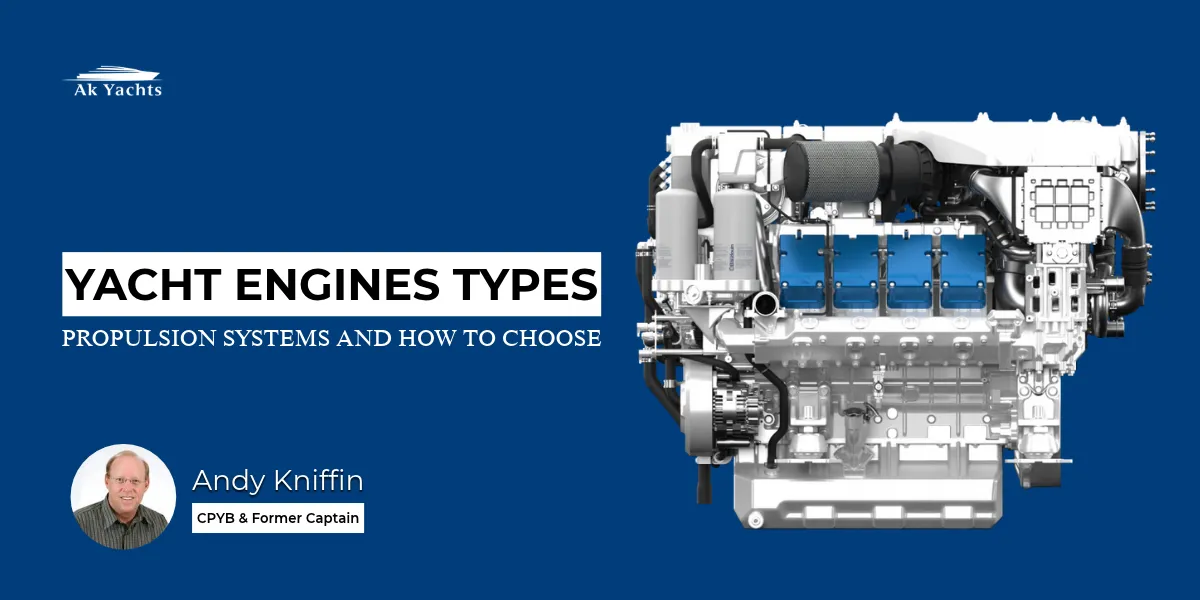
When buyers compare yachts, they tend to start with the layout, the builder and the look of the boat. Experienced owners start with the yacht engines. The engines and the way their power reaches the water decide how fast the yacht will run, how far it can travel, how easily it handles around the dock, what it costs to maintain and, in time, how well it holds its value.
The choices have widened considerably in recent years. A yacht today may be driven by diesel inboards on conventional shafts, by joystick-controlled pod drives, by a bank of large outboards or by a hybrid system that runs silently on battery power in harbor. Each suits a different kind of boat and a different kind of owner.
This guide explains the main types of yacht engines and propulsion systems, which ones suit which yachts, the engine manufacturers you will see most often in listings, and what to consider when a yacht has older engines. It reflects what I see every week as a broker in Fort Lauderdale, one of the busiest yachting markets in the world. Once you own the yacht, our companion guide to diesel engine maintenance advice explains how to keep those engines in good order.
Diesel or Gasoline?
The first question is the fuel. On smaller boats, gasoline engines remain common, and nearly all outboards run on gasoline. On yachts above roughly 40 feet, diesel is by far the norm.
Diesel engines are more fuel-efficient, especially at cruising loads, and they are built for long hours. Diesel fuel is also much less volatile than gasoline, which reduces fire and explosion risk aboard. The trade-offs are higher purchase cost, greater weight and more complex modern fuel and emissions systems.
Gasoline engines cost less to buy and are lighter for their power, which suits trailerable boats and lighter, faster hulls. They generally consume more fuel and wear sooner under the sustained loads a larger yacht demands, and gasoline vapor must be managed carefully with proper ventilation.
For most buyers looking at cruising yachts, motor yachts and sportfishing yachts, the real decision is not diesel or gasoline but which diesel and which propulsion system. Our guide to yacht fuel consumption shows how engine choice and hull type affect running costs.
Types of Yacht Propulsion
Inboard Shaft Drive
The traditional arrangement places the engines low and near the middle of the hull, driving propellers through straight shafts, with rudders for steering. Shaft drives are simple, proven and robust, and almost any marine mechanic can service them. They are the standard on most sportfishing yachts, trawlers and larger motor yachts, and they suit owners who value durability and straightforward maintenance.
The main drawbacks are that the engine room takes up valuable space amidships, and close-quarters handling depends more on skill and bow or stern thrusters. Joystick systems are now available for many shaft-drive yachts, which narrows that gap.
V-Drive
A V-drive places the engines farther aft, facing backward, with a gearbox that turns the drive forward and down to the shaft. This frees space for accommodations and is common on express cruisers and some motor yachts. Access to the engines can be tighter, which can make some service jobs slower.
Sterndrive
A sterndrive pairs an inboard engine with an outdrive unit mounted on the transom, combining inboard power with the steering and trim of an outboard. Sterndrives are common on runabouts, bowriders and smaller express cruisers, mostly with gasoline engines. The outdrive has more moving parts below the waterline and needs regular attention, particularly in salt water.
Pod Drives
Pod drives, led by Volvo Penta’s IPS system introduced in 2005, place the drive units under the hull with forward-facing propellers that pull rather than push. The pods steer by rotating, so no rudders are needed, and they are controlled by joystick.
For owners, the benefits are real: precise, low-stress docking, station-keeping functions that hold the yacht in position, and an engine room farther aft that opens up the interior. Manufacturers cite meaningful efficiency gains at cruising speed compared with conventional shafts, though results depend on the hull and installation. The trade-offs are higher cost, more complex service that is best handled by authorized dealers, and repairs that can be more expensive if a pod is damaged.
Volvo Penta now offers IPS across a wide range, up to the IPS1350 based on its D13 engine. Cummins Zeus pods are found on many yachts from the 2000s and 2010s and remain supported. Older yachts may also carry less common systems, so check parts and service support before you buy. For a fuller comparison, see our article on pod drives and direct drives.
Outboards
Outboards have moved well beyond small boats. Large center consoles, many express models and a growing number of cruising yachts in the 40 to 50 foot range now run on three, four or even more outboards. The largest models include the Mercury Verado V12 at 600 horsepower, which has a steerable lower gearcase and a two-speed transmission, and Yamaha’s V8 XTO Offshore range. A detailed review of the Verado V12 gives a sense of how far outboard technology has come.
Outboards free up the entire hull for living space and storage, can be tilted clear of the water when the boat is moored, and can be replaced individually. They burn gasoline, and running costs at speed can be high. A small number of diesel outboards exist, such as the Cox CXO300, though they are used mainly in commercial and government work. You can see current examples among our center console boats for sale.
Waterjets and Surface Drives
Waterjets draw water through the hull and expel it at high velocity, which allows very shallow draft and excellent maneuverability at speed. They appear on some fast yachts, many tenders and personal watercraft. Surface drives, where the propellers run half out of the water, are found on high-performance yachts built for top speed. Both are specialized choices that suit a specific purpose rather than general cruising.
Hybrid and Electric Propulsion
Hybrid systems pair diesel engines with electric motors and batteries, allowing silent running in harbor or at anchor and quieter, emission-free low-speed cruising. Volvo Penta has introduced a D13 IPS hybrid system, and MAN offers hybrid versions of its yacht engines. On larger superyachts, diesel-electric propulsion has been used for many years.
Fully electric yachts remain limited by battery range and charging infrastructure, and they are best suited to shorter trips, lakes and protected waters. Hybrid technology is developing quickly, so specifications and availability are worth checking at the time of purchase.
Which Propulsion Suits Which Yacht?
| Propulsion | Often found on | Main strengths | Main trade-offs |
|---|---|---|---|
| Inboard shaft drive | Sportfishing yachts, trawlers, motor yachts | Durable, simple, widely serviceable | Engine room takes interior space; handling relies on thrusters or joystick |
| V-drive | Express cruisers, some motor yachts | More interior space | Tighter engine access |
| Sterndrive | Runabouts, smaller cruisers | Compact, trimmable, lower cost | More maintenance below the waterline |
| Pod drives | Cruisers and motor yachts, roughly 35 to 80 feet | Joystick docking, efficiency, interior space | Higher cost; specialist service |
| Outboards | Center consoles, express models, some cruising yachts | Easy service, maximum interior space | Gasoline consumption at speed |
| Waterjets and surface drives | High-speed yachts, tenders | Speed, shallow draft | Specialized, less efficient at low speed |
| Hybrid | Newer cruising and motor yachts | Quiet running, lower emissions in harbor | Higher cost; evolving technology |
The table is a general guide only. The hull matters as much as the engines. A displacement trawler needs modest, economical power for long range, while a planing sportfisher needs high output to reach and hold speed. Our article on planing vs displacement hulls explains the difference.
Not Sure Which Engines Suit Your Plans?
How you plan to use the yacht should guide the engines and propulsion you choose. Andy Kniffin, CPYB, a former professional captain, can help you weigh the options and find yachts that fit the way you boat.
Major Yacht Engine Manufacturers
You will see the following names again and again in yacht listings. Each has strong dealer support in South Florida.
Caterpillar
Caterpillar engines are a mainstay of sportfishing yachts and motor yachts, with a reputation for durability and wide dealer support. Current yacht engines include the C8.7 and C12.9, developed with FPT, along with larger C18 and C32 models. Older yachts often carry the 3196, 3406 and 3412, which remain well regarded when maintained. Many sport fishing yachts for sale, including those from builders such as Viking, run on Caterpillar or MTU power.
MTU
MTU, part of Rolls-Royce Power Systems, builds high-output engines for large motor yachts, fast sportfishing yachts and superyachts, notably the Series 2000 and Series 4000. In 2023, the company announced that these yacht engines were released for sustainable fuels such as HVO that meet the EN15940 standard.
MAN
MAN is a leading supplier to European builders and to yachts in the 50 to 120 foot range. Its yacht engine range runs from an inline six of 12.4 liters to V12 engines of up to 29.6 liters, with outputs of more than 2,000 horsepower at the top end, and hybrid versions are available.
Volvo Penta
Volvo Penta covers a broad range, from smaller D4 and D6 diesels to the 12.8-liter D13, and is best known for its IPS pod system. It also builds gasoline sterndrives and its Forward Drive for wake sports.
Cummins
Cummins engines are common on sportfishing yachts, cruisers and trawlers. The QSM11 was a long-standing favorite on yachts from the 2000s, and current Cummins marine engines remain widely supported. Cummins pioneered Zeus pods with Mercury before the two companies ended their joint venture in 2012.
Yanmar, John Deere and Others
Yanmar is a leading name in smaller yachts, sailboats and many trawlers, with engines such as the 6LY, 6LF and 6LT series. John Deere marine engines are valued in trawlers and long-range cruisers for their economy and durability. Scania, FPT and others appear in a range of European and commercial-style yachts. When you look at used trawler yachts for sale, you will often find these lower-revving, long-life engines.
Detroit Diesel and Other Legacy Engines
Many older yachts still run on Detroit Diesel two-stroke engines such as the 6V92, 8V92 and 12V71, which powered a generation of American sportfishing and motor yachts. These engines are no longer built because they cannot meet current emissions standards, but parts and rebuild expertise remain available through aftermarket suppliers and specialist shops. They are louder and less fuel-efficient than modern engines, though many still run well.
Buying a Yacht With Older Engines
Older engines are not a reason to walk away. Many well-maintained yachts with older engines offer real value. What matters is the condition and documentation:
- Ask for complete service records, including oil analysis reports.
- Commission a separate engine survey by a qualified surveyor or manufacturer-trained technician.
- Run the engines at full load during the sea trial and confirm they reach rated RPM without excessive smoke or temperature.
- Check parts availability and dealer support for the specific engine model.
- Price in the cost of a possible rebuild or repower if the engines are nearing major service.
A repower is a significant project, and its cost depends heavily on the yacht and the engines chosen, so obtain quotes before relying on it in your budget. Our guides on what happens during a yacht survey and how to weigh new vs used boats cover the wider buying process.
Emissions Rules and Newer Engines
Emissions standards shape which engines builders can install. In the United States, new recreational marine diesel engines must meet EPA standards, and engine makers have redesigned their ranges to comply.
For larger yachts, the international IMO Tier III limits on nitrogen oxides also apply. As a general summary, yachts of 24 meters or more in length and under 500 gross tons, built on or after January 1, 2021, must meet Tier III when operating in a designated emission control area, which includes the waters off most of the United States and the US Caribbean. Recreational yachts under 24 meters are generally exempt. A classification society advisory sets out the rules in more detail. Meeting Tier III often requires exhaust after-treatment, such as selective catalytic reduction with a urea-based fluid, which adds equipment and maintenance.
These rules are technical and depend on the yacht’s size, build date, engine power and operating area. Buyers of larger new or recent yachts, and those importing a yacht into the United States, should seek advice from the builder, a qualified marine engineer or a maritime attorney.
Conclusion
The right yacht engines depend on how you plan to use the boat. Shaft-driven diesels remain the dependable choice for offshore fishing and long-range cruising. Pod drives make larger yachts easier to handle and roomier inside. Modern outboards have opened a new class of fast, open yachts, and hybrid systems are bringing quieter running to the dock and the anchorage.
Whatever you choose, the engines should match the hull, the cruising grounds and the owner. Condition and service history count as much as the brand on the engine cover.
Find a Yacht With the Right Power
From sportfishing yachts on Caterpillar power to pod-driven motor yachts, Andy Kniffin, CPYB, can help you compare engines, review service records and find the yacht that fits. View our motor yachts for sale or speak with our Fort Lauderdale yacht broker.
Frequently Asked Questions
What engines are most common on yachts?
Diesel inboards are the most common on yachts over about 40 feet, from manufacturers such as Caterpillar, MTU, MAN, Volvo Penta, Cummins and Yanmar. Smaller and center console yachts increasingly use large gasoline outboards.
Are pod drives better than shaft drives?
Neither is better in every case. Pods offer easier docking, interior space and often better efficiency at cruising speed. Shaft drives are simpler, more robust and easier to service, which is why they remain the standard on most sportfishing yachts and trawlers.
Is a diesel or gasoline engine better for a yacht?
For most yachts above 40 feet, diesel is preferred for its efficiency, durability and safer fuel. Gasoline engines suit smaller, lighter boats where lower purchase cost and weight matter more.
Can a yacht with outboards cruise long distances?
Yes, within the limits of its fuel capacity and gasoline consumption. Many outboard-powered yachts make regular crossings from South Florida to the Bahamas, but range planning matters more than on a diesel-powered yacht.
Are older Detroit Diesel engines still worth buying?
They can be, if they have been well maintained and pass a thorough engine survey. Parts remain available through aftermarket suppliers, but these engines are louder and less efficient than modern diesels, and that should be reflected in the price.
What is a hybrid yacht engine?
A hybrid system combines diesel engines with electric motors and batteries, allowing quiet, low-emission running at low speeds and in harbor, with diesel power for longer passages.
How many hours is too many for a yacht engine?
There is no single number. Engine design, duty rating, operating habits and maintenance history matter more than hours alone. A well-maintained engine with high hours can be a better purchase than a neglected one with few.
Do emissions rules affect yachts I might buy?
They mainly affect newer yachts of 24 meters and above, which may carry exhaust after-treatment systems to meet IMO Tier III. Ask your broker and surveyor to confirm compliance and service needs for any such yacht.
This article provides general information only. Engine specifications change, and emissions, import and regulatory requirements depend on each yacht’s circumstances. Consult the manufacturer, a qualified marine engineer or a maritime attorney before making decisions.