When shopping for a yacht or planning a repower, one of the biggest decisions owners and captains face is the choice between conventional propulsion (Direct or V-Drive systems) and modern pod-style systems like Volvo Penta IPS (Inboard Performance System) or Cummins Zeus and ZF. All have passionate supporters, and both have evolved significantly over the last decade. But if you narrow the decision down to reliability when cruising and long-term ownership experience, how do they really stack up?
Note that pod drives are limited to 1,000 horsepower engines at this point in time. Larger horsepower engines always run direct drive propulsion (or water jet).
Let’s break it down in clear, real-world terms.
Understanding the Systems: What’s the Difference?
Direct & V-Drive Propulsion (Traditional)
In traditional yacht propulsion:
A conventional shaft runs from the engine to a propeller strut through the hull.
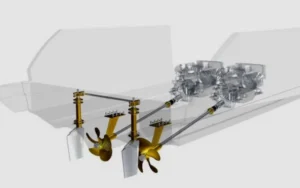
In Direct Drive, the engine faces forward and drives the shaft straight back.
In a V-Drive configuration, commonly used in twin-engine boats, engines are mounted aft facing backward; power is routed forward through a gearbox, then out to the propellers with a rudder behind it.
This age-old setup is simple, rugged, and has been in service for decades.
Pods
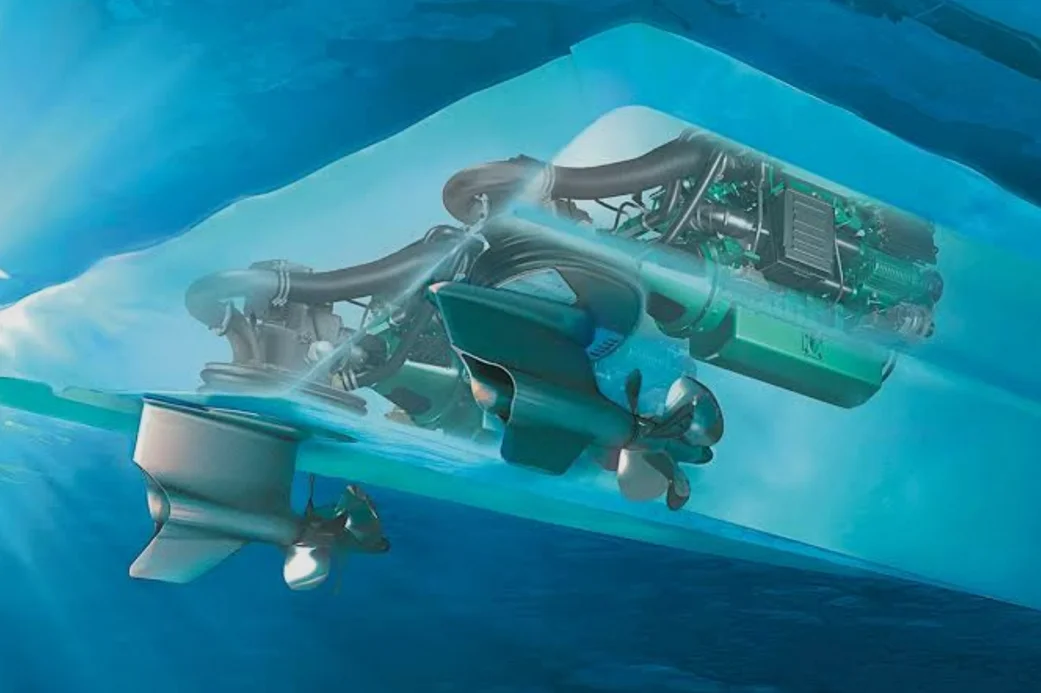
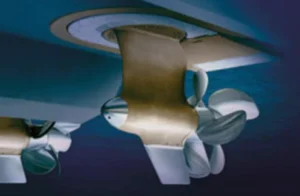
Have a short shaft between the engine and the gearbox which drives a self contained drive unit mounted under the hull with counter-rotating propellers.
- The pods pivot for steering, replacing traditional rudders.
- The system includes integrated joysticks and digital controls that make low-speed handling very intuitive.
- Pods represents a big rethink in propulsion — trading conventional shafts and rudders for underwater drive units and advanced electronic management.
Common Metrics Owners Care About
Before we dive into reliability specifically, here’s a quick look at the broader yardsticks buyers consider:
| Feature | Direct/V-Drive | IPS |
| Maneuverability | Good | Excellent (especially with joystick) |
| Fuel Efficiency | Moderate | Often better |
| Top Speed | Depends on Hull/Prop | Often comparable or better |
| Complexity | Simple | More complex |
| Maintenance Costs | Lower in many cases | Potentially higher |
| Reliability | Traditional rugged proven | Modern reliable but different wear factors |
Now — let’s zoom in on reliability.
Reliability: Direct/V-Drive
Pros
Simple Mechanics
- Fewer moving parts than pod systems.
- Shaft, stuffing box, bearings, gearbox — all serviceable with widely available parts.
- Many mechanics understand these systems — they’ve been standard for generations.
Proven Track Record
- Sailboats, fishing vessels, ferries, tugboats — similar shaft systems are still the backbone of commercial marine propulsion worldwide.
- Basic mechanical systems often outlive more complex electronics.
Predictable Failure Modes
- If a seal leaks, you see water.
- If a bearing fails, vibration alerts you early.
- These systems don’t hide problems behind layers of electronics.
Easier Field Repair
Many problems can be fixed in small boat yards without specialized diagnostic tools.
Cons
Wear from Misalignment
- Shaft angle and alignment matter — if they shift over time (due to hull flex or engine mounts settling), bearings and seals suffer.
- Alignment checks are simple but often overlooked.
Stuffing Box Maintenance
Traditional packing glands need adjustment and occasional replacement. Neglect can lead to leaks.
Reliability:
It is mechanically straightforward and well-understood. Failures tend to be wear-related and observable. With regular alignment checks and basic maintenance, these systems are very reliable.
Reliability: Volvo Penta IPS and Cummins Zeus
Unique Design Features
- Forward-facing counter-rotating pods (Volvo Penta IPS) that pull the boat instead of pushing.
- Joystick control systems tied into engine, transmission, and pod geometry. Many pods feature ‘skyhook’ technology allowing the boat to remain stationary ‘hands-free’
- Integrated electronics and sensors for trim, thrust vectoring, and diagnostics.
Pros
Engineered Redundancy
Twin pods often mean if one pod has an issue, you still have some control with the other.
Redundant sensors and built-in diagnostics help forewarn problems.
Efficient Hydrodynamics
Reduced drag, better fuel economy, and less cavitation reduce loads — especially in rough conditions.
Comprehensive Diagnostics
Advanced error reporting can pinpoint issues early.
Many technicians can pre-diagnose before a failure blossoms into something bigger.
Cons
Complexity
- More moving parts underwater (pods, bevel gears, hydraulic steering rams).
- Integrated electronics add complexity; sensors and software components can be failure points.
- Pods are prone to below water ingress and corrosion if the seals and sacrificial zincs are not maintained properly.
- Your propellers (IPS) are the first source of impact on submerged objects.
Specialized Service
- Technicians need specific training and diagnostic tools to interpret electronics.
- In remote cruising areas, skilled techs may be harder to find than traditional diesel mechanics.
Cost of Repairs
Replacing a pod or major electronic component is significantly more restrictive and expensive than swapping a propeller or shaft.
Water Intrusion Risk
The pod gearbox lives below the hull with seals that must remain intact under complex loads. Seal failures can lead to water ingress into the pod’s internal gear housing — a credible worry if not monitored. Propeller seals are especially sensitive, thus the gear unit should be checked daily for any signs of ‘milkiness’ indicating water intrusion.
Grounding or underwater impact
Pods are designed to tear off with a seal to protect the hull against catastrophic flooding. So, if you happen to do a hard grounding or hit a submerged object, you run the risk of losing the external pod drive. You will be at the mercy of ordering a new one and getting it re-installed.
Cummins Zeus and ZF pods are still found on many mid-sized yachts. Even though they are not made any longer, there are still technicians and parts to be found.
Pod Reliability:
Pods are very reliable when well maintained, but it demands a disciplined maintenance approach, familiarity with the system, and access to trained technicians.

Speak With Andy Kniffin
Andy Kniffin is a CPYB Certified Professional Yacht Broker and Former Captain, helping yacht buyers and sellers make confident decisions with practical market insight and hands-on yachting experience.
Comparing Reliability in Real World Terms
Failure Modes
Direct/V-Drive:
- Shaft seal wear, coupling fatigue, bearing wear.
- Usually gradual and observable.
Pods:
- Pod seal degradation, sensor failures, electronic glitches, hydraulic actuator issues.
- Some can be sudden if diagnostics aren’t monitored.
Maintenance Discipline
This is perhaps the biggest determinant of reliability:
- A meticulously maintained IPS system in a well-supported cruising ground can outperform a neglected V-Drive — both in reliability and performance.
- Conversely, an owner unfamiliar with IPS may miss electronic alerts or skip software/firmware updates that can prevent issues.
- It is important to keep the coolers, seals and zincs up to date
So… Which Is More Reliable?
Here’s the honest, nuanced answer:
If you want “bulletproof simplicity”
Direct/V-Drive wins.
Lower mechanical complexity, fewer electronic dependencies, easier worldwide service, and predictable problem signs make it ideal for owners who value straightforward reliability above all.
If you want “modern performance with reliability when maintained”
Pods are a strong contender and more available than direct drive yachts.
It’s not inherently less reliable — it’s just different. You trade mechanical simplicity for integrated electronic and mechanical precision. When the owner and tech team understand the system, service it properly, and monitor diagnostics closely — pods can be just as dependable as traditional propulsion — often more efficient and enjoyable to operate.
Final Thoughts
Reliability isn’t just about the hardware — it’s about the ecosystem surrounding it:
Maintenance philosophy – Consistent, proper servicing beats theoretical reliability every time.
Service access – If you cruise in remote areas without Volvo trained techs, conventional systems have a serious edge.
Monitoring and diagnostics – IPS gives you more data — but you must use it to catch issues early.
Usage style – If you’re new to docking and value features like “skyhook” station-keeping, reduced engine noise, and a slight edge in fuel economy, pod drives offer a clear advantage. On the other hand, if you prefer a robust propulsion system that’s generally simpler and less expensive to repair and maintain, direct or V-drives are often the better choice—keeping in mind that this may narrow your yacht options to those built around that propulsion setup.
Both systems have matured. Neither is “inherently unreliable.” But they ask different things of the owner: one asks for mechanical vigilance, the other asks for technical discipline and care not to ground the boat. Reliability will be shaped more by the care you give it.
The Bottom Line
Pods have been installed in a clear majority of mid-sized yachts (35-70’) as they offer the ability to add more interior volume to a yacht, plus easy maneuverability for novice operators and better fuel economy.
Many pod owners have been very happy with these, knowing how to keep them safe and reliable.
In the real world, experienced cruisers know that direct drive units dock well using twin propellers and a thruster (when needed). Most experienced operators would shrug off using a joystick, preferring the simplicity of individual gear controls with occasional thruster use.
Attention Loopers!
Those who cruise the Great Loop in North American know that it’s not a matter of if, but when an underwater impact will occur…especially in shallow/murky water and rivers. On a direct drive yacht, most of the time a spare set of propellers can simply be swapped out and on you go. It is much more complicated if you damage or lose a pod drive, even if you can find service locally.
Yachts for Sale
There are always plenty of pod-equipped boats on the market—not because owners are eager to get rid of them, but because pods have become extremely common. In fact, they may account for as much as 80% of modern mid-sized yachts.
With that said, however there are select, modern direct driven mid-sized yachts for sale. Some manufacturers produced models offering either drive style.
Finding a nice direct or v-drive mid-sized yacht is not always easy…but trust me…they are always out there on the market.
Contact Andy Kniffin (954) 292-0629, andy@akyachts.com if I can help you find the ideal yacht to match your goals! We are longtime experts in this field.